-
20-year dedicated manufacturer
-
Certified Company
ISO 9001:2015

Beryllium Copper in Plastic Injection Molds: Benefits & Best Practices
Introduction
In plastic injection molding, cooling time accounts for 50–70% of the total cycle time. Any reduction in cooling time translates directly to increased production output and lower per-part cost. This is where beryllium copper mold inserts deliver exceptional value.
Beryllium copper's thermal conductivity (195–260 W/m·K for C17500) is 3–5 times higher than tool steel (25–40 W/m·K). By strategically placing BeCu inserts in areas with poor cooling, molders can achieve dramatic cycle time reductions—often 20–40%.
Why Beryllium Copper Works in Molds
Three properties make beryllium copper ideal for mold applications:
1. Thermal conductivity: Heat moves rapidly from the molten plastic into the BeCu insert and out through the cooling channels. This is the primary reason for using BeCu in molds.
2. Strength and hardness: C17200 age-hardened to 38–42 HRC approaches P20 tool steel hardness (28–32 HRC). It can withstand injection pressures (up to 200 MPa) without deformation.
3. Polishing and texturing: BeCu accepts high-gloss polishes (SPI A1 finish) and can be photo-etched for textured surfaces—important for cosmetic parts.
Grade Selection for Mold Applications
Two grades dominate mold applications, each with specific advantages:
• C17200: Maximum hardness (38–42 HRC) for structural mold components, core pins, and inserts in high-pressure molds. Preferred when mechanical wear resistance is critical.
• C17500: Higher thermal conductivity (195–260 W/m·K vs 105 W/m·K) for heat removal applications. Preferred for large inserts and cooling-intensive areas. Slightly softer (20–28 HRC) but sufficient for most mold pressures.
Many molds use both grades strategically: C17500 for large heat-transfer inserts and C17200 for high-wear areas like core pins and gate inserts.
Mold Component Applications
Beryllium copper is used in these mold components:
• Core pins and inserts: In areas where plastic flow is thick or cooling is poor, BeCu pins dramatically reduce cooling time.
• Cavity inserts: For cosmetic parts requiring flawless surface finish, BeCu inserts polish to mirror quality.
• Hot runner nozzles: BeCu nozzles provide thermal uniformity, reducing color variation and gate defects.
• Slider inserts: In molds with moving sliders, BeCu inserts combine wear resistance with thermal efficiency.
• Conformal cooling inserts: For complex geometries where conventional cooling channels cannot reach, BeCu bridges the thermal gap.
Design and Machining Best Practices
To get the most from beryllium copper mold components:
1. Machine in the annealed condition: BeCu is supplied soft (TB00) for easy machining. Complete all machining before age hardening to avoid post-heat-treatment distortion.
2. Age hardening after machining: Standard cycle is 315 °C for 3 hours (C17200) or 480 °C for 3 hours (C17500). Use a calibrated furnace with ±5 °C uniformity.
3. Design cooling channels close to the insert surface: Maximize the thermal advantage of BeCu by placing cooling channels within 5–10 mm of the molding surface.
4. Thermal interface: Ensure metal-to-metal contact between the BeCu insert and mold base. A thin layer of thermal paste or interstitial copper foil can improve heat transfer at the interface.
5. Surface finish: For optical parts, polish BeCu inserts after age hardening. The material takes an excellent polish comparable to hardened tool steel.
Cost-Benefit Analysis
While beryllium copper costs more per kilogram than tool steel, the ROI is compelling. Consider a mold producing 1 million parts per year:
• Tool steel mold cycle: 30 seconds per shot → 1,000,000 parts/year
• With BeCu inserts cycle: 20 seconds per shot → 1,500,000 parts/year (+50%)
• Additional BeCu insert cost: $2,000–5,000
• Additional production value: $50,000–200,000/year
The payback period is typically measured in weeks, not months.
Source BeCu Mold Material from JY
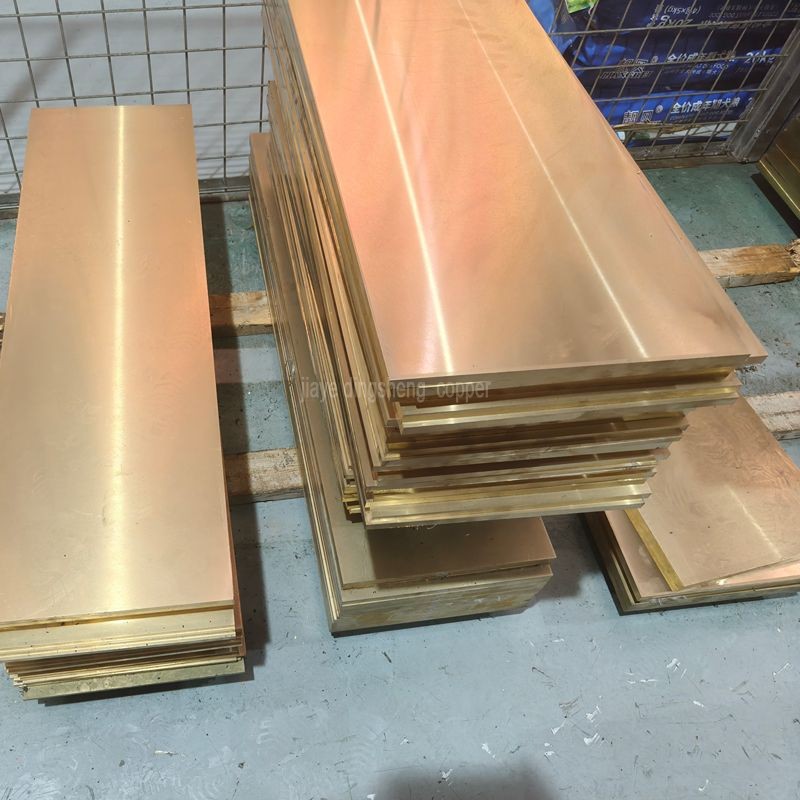
JY Beryllium Copper supplies C17200 and C17500 plate and bar specifically for mold applications. We offer pre-cut sizes, custom forgings, and can supply material in solution-annealed condition for in-house machining.
Our BeCu mold materials are ultrasonically tested to ensure freedom from internal defects that could cause mold failure. Mill test certificates accompany every shipment.
Contact js01@jstongcai.com.cn for mold-grade BeCu plate and bar, or to discuss your specific mold application.
# Tags:
-
Injection Molding, C17200, C17500