-
20-year dedicated manufacturer
-
Certified Company
ISO 9001:2015

Beryllium Copper Heat Treatment: Aging Temperature & Time Guide
Why Heat Treatment Matters
Beryllium copper's remarkable mechanical properties are not fully realized in the as-cast or as-rolled condition. The alloy's true potential is unlocked through precipitation hardening—a controlled heat treatment process that causes nanometer-scale beryllium-rich particles to form within the copper matrix. Without proper age hardening, even the highest-quality BeCu will deliver only a fraction of its rated strength.
This guide covers the critical parameters for heat treating the most common beryllium copper grades.
Solution Annealing
Before age hardening, beryllium copper is typically supplied in the solution-annealed condition (Temper TB00 for C17200). Solution annealing involves heating the alloy to 760–800 °C to dissolve beryllium atoms uniformly into the copper matrix, followed by rapid quenching in water.
In this soft condition, the material is readily formable—suitable for stamping, bending, and deep drawing. After forming, the component is age-hardened to achieve final properties. Once hardened, the material becomes too hard for extensive cold forming.
Age Hardening Parameters
Grade | Aging Temp (°C) | Time (h) | Hardness (HRC) | Conductivity (% IACS) |
C17200 | 315 | 3 | 38–42 | 15–22 |
315 | 3 | 38–42 | 15–22 | |
C17000 | 315 | 3 | 32–38 | 18–25 |
C17500 | 480 | 3 | 20–28 | 45–60 |
C17510 | 450 | 3 | 20–28 | 45–60 |
Age hardening (also called precipitation hardening or aging) is performed at moderate temperatures. The specific parameters depend on the alloy grade and the balance between strength and conductivity required.
Effect of Over-Aging
Aging is sensitive to time and temperature. Over-aging (too long or too hot) causes the precipitates to coarsen, reducing strength and hardness. Under-aging (too short or too cool) leaves potential strength unrealized.
For C17200, exceeding 330 °C or extending beyond 4 hours typically results in measurable strength loss. Always use calibrated furnaces with temperature uniformity within ±5 °C. For thin strips, protective atmospheres (nitrogen or argon) prevent oxidation.
Hardness Development
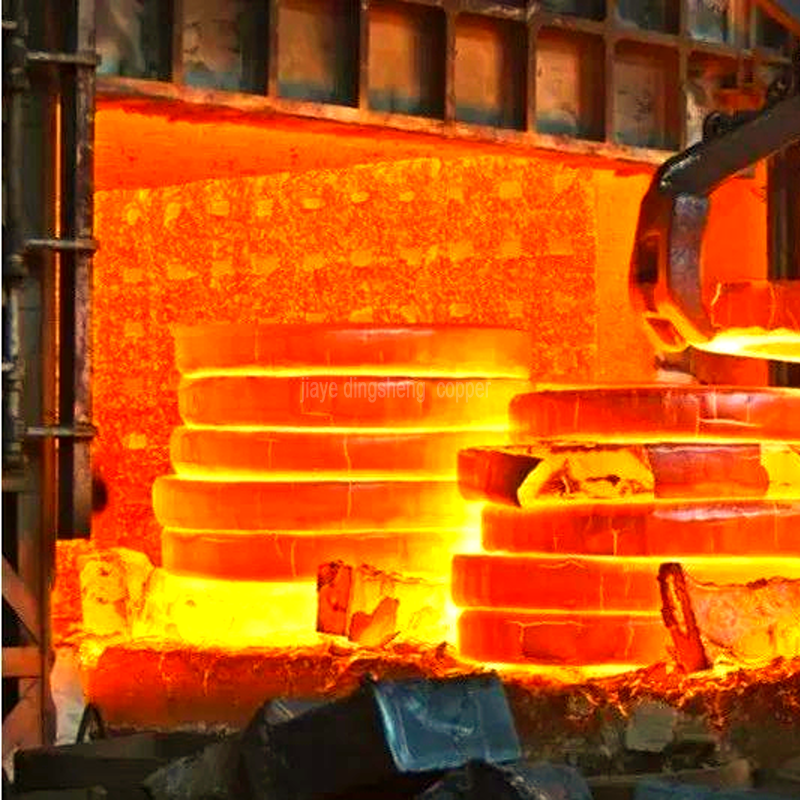
The age-hardening response is rapid. C17200 reaches 90% of peak hardness within the first 2 hours. For applications requiring slightly lower hardness but improved ductility (such as complex stampings), reduced aging at 300 °C for 2 hours can be specified.
For C17500, the hardness curve is more gradual. Peak properties develop at 3–4 hours. Some manufacturers use step-aging (double aging) for C17500 to optimize both conductivity and strength simultaneously.
Quality Control in Heat Treatment
Critical quality checks after heat treatment include:
• Hardness testing (HRC or HV) on a sample from each batch
• Dimensional inspection (some growth of 0.02–0.05% can occur during aging)
• Conductivity measurement (for C17500 applications)
• Metallographic examination for grain size and precipitate distribution
At JY Beryllium Copper, every heat-treated batch is tested for hardness uniformity. Our furnaces are calibrated to AMS 2750 standards, and we provide mill test certificates with full property data.
Need Help with Heat Treatment?
If you are unsure about the optimal heat treatment for your application, our technical team can provide recommendations based on your component geometry, required strength, and operating environment. We also supply material in the pre-hardened condition if you prefer to skip in-house heat treatment.
Contact us at js01@jstongcai.com.cn for technical consultations and customized heat treatment solutions.
# Tags:
-
Beryllium Copper 、Heat Treatment、Hardness Development
C17200 vs C17500: Which Beryllium Copper Alloy to Choose?
Previous Post